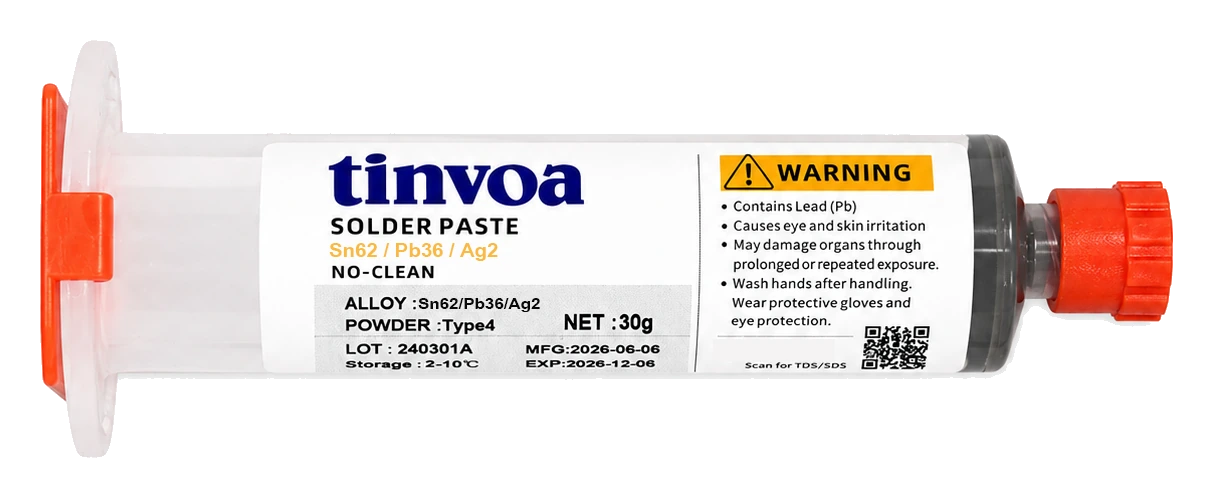
This leaded alloy is a specialty product for soldering silver / silver-palladium terminations. Sold direct for professional and OEM use — not listed on Amazon. Tell us your termination type, pad/pitch, and volume and we'll reply with pricing, formats, and full documentation.
A standard tin-lead solder will dissolve thin silver layers during reflow. The 2% silver in this alloy stops that — protecting the very components other pastes damage.
2% dissolved silver pre-saturates the melt, so it no longer scavenges silver from Ag / Ag-Pd terminations and platings.
Slightly lower melt than Sn63/Pb37 (183°C), with smooth wetting and bright, reliable leaded joints.
Fine powder options and >8 h open stencil time hold definition on small pads and tight pitch.
Halide-free synthetic-resin flux — <0.05% by weight in flux solids (IPC-TM-650 2.3.28.1) — no cleaning required after reflow.
"Silver leaching" (or silver scavenging) is when molten solder dissolves the thin silver metallization on a component. Add silver to the solder and the driving force disappears.
Molten Sn63/Pb37 is "hungry" for silver. On a silver or silver-palladium termination it rapidly dissolves the thin Ag layer into the solder.
The result: eroded metallization, weak or open joints, and reduced adhesion — especially with repeated or prolonged heating.
Pre-loading the solder with 2% silver raises its silver activity to near saturation, so it no longer pulls silver out of the component's termination.
The metallization stays intact, the joint is strong and repeatable — exactly what silver-terminated passives and thick-film parts need.
Typical values for tinvoa Sn62/Pb36/Ag2 leaded solder paste. Full TDS and SDS supplied on request.
Typical values are not specifications. Lot-specific data available on request.
| Alloy Composition | Sn 62% / Pb 36% / Ag 2% |
| Melting Point | 179°C (near-eutectic) |
| Silver Function | Suppresses silver leaching on Ag / Ag-Pd terminations |
| Appearance | Gray smooth paste · odourless |
| Paste Density | ≈ 4.6 g/cm³ |
| Powder Particle Size | Type 4 · 20–38 μm or Type 5 · 15–25 μm · by format (IPC J-STD-005A) |
| Flux Type | No-Clean Synthetic Resin · REL0 (IPC J-STD-004B) |
| Halide Content | Halide-free — <0.05% by weight in flux solids (IPC-TM-650 2.3.28.1, ion chromatography) |
| Printability / Open Time | > 8 h continuous printing · print speed up to 150 mm/s |
| Tack / Adhesion | Holds components > 24 h after print |
| Surface Insulation Resistance | > 2.6 × 10¹⁰ Ω after 7 days (85°C / 85% RH) |
| Standards | ISO 9454-1 (1.2.2.3) · IPC J-STD-004B |
| Cleaning | No-Clean — cleaning not required (alcohol PCB cleaner if desired) |
| Recommended Stencil | 100 μm foil for pitch ≤ 0.4 mm · 150 μm for pitch ≥ 0.5 mm |
| Package Options | 30 g / 50 g · resealable luer-lock syringe · SKU TSP-PB36AG2-30G / -50G |
| Storage / Shelf Life | 6 months refrigerated (2–10°C / 36–50°F), tightly sealed · warm to room temp before opening |
| Lead Content / Compliance | Contains lead — not RoHS-compliant · California Prop 65 warning applies · DOT ground: typically non-regulated · air/ocean: verify SDS Section 14 |
Sn62/Pb36/Ag2 melts at 179°C. Target a 210–220°C peak with 30–60 s above melt. Depending on oven vs. hot-air, you may need +10–20°C over the nominal profile.
Suitable for reflow in air or nitrogen, and stencil printing with laser-cut or electroformed foils. Full guidance in the TDS ↓.
Leaded alloy. Classified under OSHA HazCom 2024 (GHS). Refer to the product SDS for the complete, authoritative classification.
This product can expose you to lead, which is known to the State of California to cause cancer and birth defects or other reproductive harm. For more information go to www.P65Warnings.ca.gov.
Full classification in the Safety Data Sheet ↓
Because this is a leaded product, documentation is provided directly on inquiry so we can confirm your application and destination.
Sn62/Pb36/Ag2 alloy specs — physical/chemical properties, silver-leach behaviour, and the leaded reflow profile.
Bench guide: warming, stencil printing, reflow at 210–220°C peak, and post-reflow inspection.
OSHA/GHS-compliant safety info for a lead-bearing solder — handling, storage, first-aid, hazmat transport, disposal.
Lead-exemption status under EU directives 2011/65/EU and 2015/863 — for applications outside EU RoHS scope (e.g., military, aerospace) or covered by a specific RoHS exemption.
SVHC declaration under EU REACH (EC 1907/2006). Lead is a listed Substance of Very High Concern.
Lot-traceable statement of conformance to this product's specification. Issued per lot with wholesale orders.
Soldering parts with silver or silver-palladium terminations — chip resistors and capacitors with Ag-Pd ends, LTCC, and silver-plated pads. Plain tin-lead dissolves thin silver layers during reflow (silver leaching); the 2% silver in Sn62/Pb36/Ag2 suppresses it. The alloy melts at 179°C.
Peak at 210–220°C with 30–60 s above 179°C, after a 140–170°C soak. It works in air or nitrogen. For stencil printing, use a 100 µm foil for pitches of 0.4 mm and below, and 150 µm for 0.5 mm and above.
By inquiry only — it is not sold on Amazon. It comes in 30 g and 50 g syringes, with bulk jars, custom packaging and private label on request. It contains lead, is not RoHS-compliant, and carries a California Prop 65 warning. Send an inquiry.
Sn62/Pb36/Ag2 is a specialty leaded alloy sold direct — not on Amazon. Tell us your parts and volume and we'll send pricing, formats, and full compliance documentation.