Ships from our U.S. warehouse · $4.99 flat shipping · Free on orders of $49.99+ with code FREESHIP at checkout · Shipping & returns
Complete specs for Sn42/Bi57.6/Ag0.4 silver-added low-temp solder paste.
Typical values are not specifications. Lot-specific data available on request.
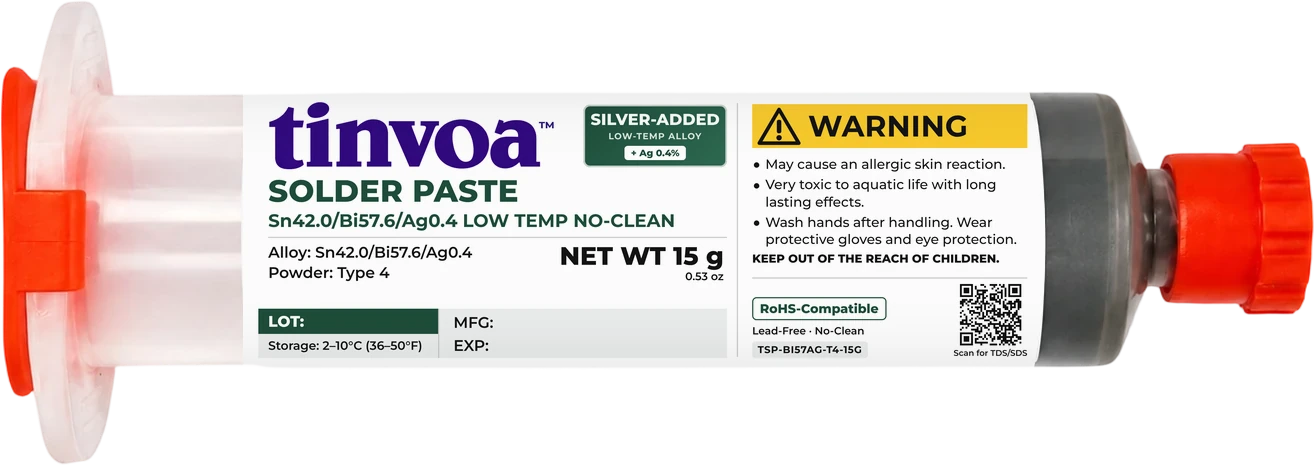
| Alloy Composition | Sn 42.0% / Bi 57.6% / Ag 0.4% |
| Melting Point | 138°C solidus · near-eutectic |
| Flux Type | No-Clean Rosin · ROL0 (IPC J-STD-004B) |
| Halide Content | Halide-free — <0.05% by weight in flux solids (IPC-TM-650 2.3.28.1, ion chromatography) |
| Powder Particle Size | Type 4 · 20–38 μm · ultrasonic-atomized powder by Lingsko (how it's made) |
| Metal Content (wt %) | ≈ 88.5 ± 0.5% |
| Package Options | 15 g · resealable luer-lock syringe · SKU TSP-BI57AG-T4-15G |
| Shelf Life | 6 months refrigerated (2–10°C) · ≥ 24 h working time |
| Compliance | RoHS · REACH SVHC declared · Flux ROL0 per IPC J-STD-004B · Paste per IPC J-STD-005A · Alloy per IPC J-STD-006C |
| Recommended Stencil | 4–6 mil (Type 4) · area ratio ≥ 0.66 |
The 0.4% silver addition does not change the low-temp profile: reflow ~30°C above the 138°C melt. Keep peak ≤170°C — excess heat oxidizes bismuth and degrades joint strength.
For LED strip hand-soldering: use a 1.0 mm hot-air nozzle and bring the joint to 160–170°C (the tool set point usually needs to be higher). Hold for 3–5 s after melt flow is visible. Full guidance in the TDS ↓.
Silver-added bismuth-tin alloy. Classified under OSHA HazCom 2024 (GHS). Refer to the product SDS for the complete, authoritative classification.
California Proposition 65: no listed chemical is intentionally added to this lead-free formulation.
Sn42/Bi57.6/Ag0.4 alloy composition, flux, handling and safety data (138 °C solidus).
Step-by-step low-temp bench guide: warming, stencil printing, reflow at 160–170 °C peak, post-reflow inspection.
OSHA/GHS-compliant safety information. Handling, storage, first-aid, transport, and disposal protocols.
Lead-free verification under EU directive 2011/65/EU and 2015/863.
SVHC (Substances of Very High Concern) declaration under EU REACH (EC 1907/2006).
Lot-traceable statement of conformance to this product's specification. Issued per lot with wholesale orders.
It is the same low-temperature bismuth-tin system with 0.4% silver added. The melt point and reflow profile are essentially unchanged (138°C). Small silver additions are used across the industry to refine the tin-bismuth microstructure, which generally makes joints less brittle than plain Sn42/Bi58. Choose it when joints will see some flexing or thermal cycling; choose Sn42/Bi58 when you want the larger 30 g or 50 g sizes.
Yes. Like Sn42/Bi58 it melts at 138°C, so it protects LED adhesives, flex substrates and heat-sensitive parts. In an oven or on a hot plate, peak at 160–170°C with 30–60 s above 138°C. With hot air, use a 1.0 mm nozzle and bring the joint to 160–170°C — the tool's set point usually needs to be higher — then hold for 3–5 s after the paste flows.
No. Lead mixed into tin-bismuth forms a phase that melts near 96°C and weakens the joint. Remove old tin-lead solder completely before reworking, and don't use it on tin-lead plated leads or pads.
Silver-added low-temp paste is mostly used for repair, rework and small batches, where 15 g is enough and stays fresh. It is the same Type 4 (20–38 µm) paste with no-clean ROL0 flux in a resealable luer-lock syringe. Use 20G–22G needles; Type 4 paste suits pitches of about 0.5 mm and above. For bulk quantities, request a wholesale quote.
Sn42/Bi57.6/Ag0.4 ships from our U.S. warehouse — $4.99 flat, free on orders of $49.99+ with code FREESHIP. Bulk and OEM orders ship with full compliance docs.