*DOT ground transport is generally not regulated for retail quantities. Air and ocean shipments should be reviewed against the current SDS and applicable regulations.
Typical values are not specifications. Lot-specific data available on request.
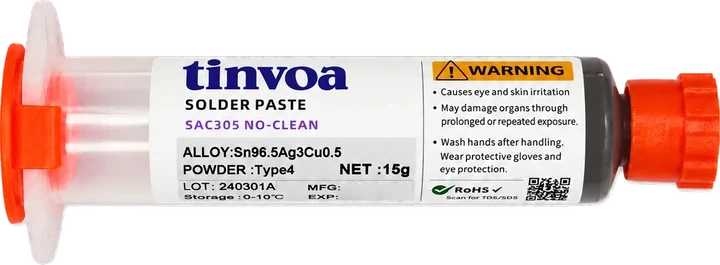
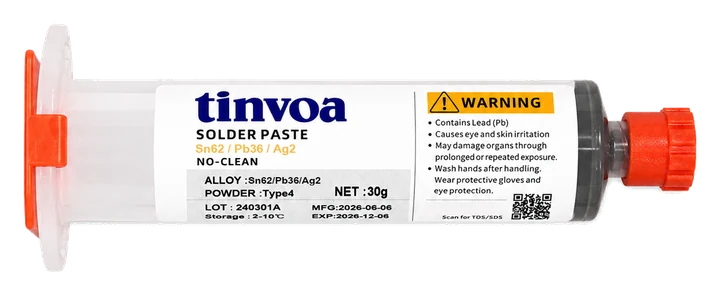
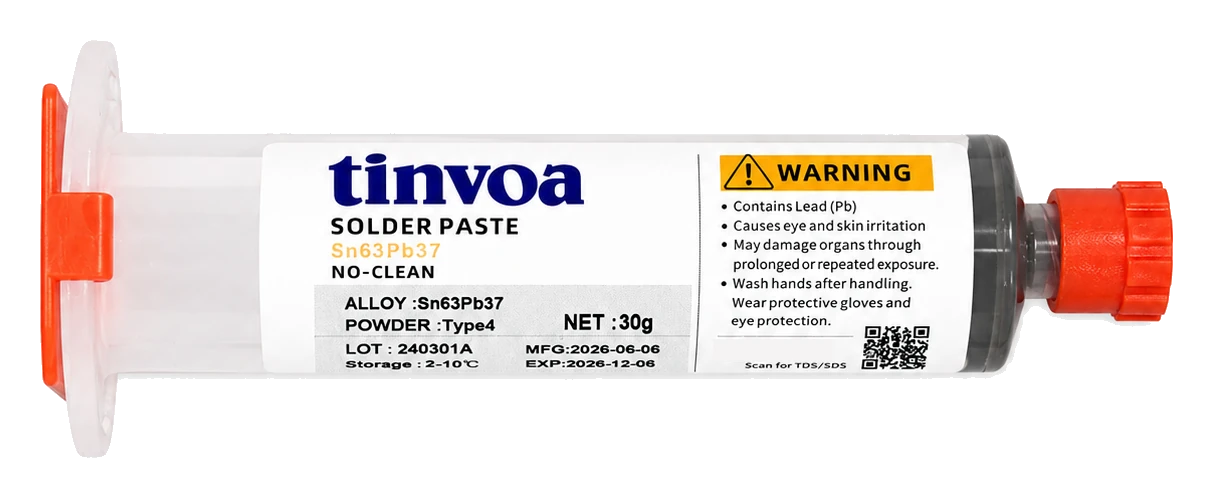
| Alloy Composition | Sn 63% / Pb 37% (eutectic) |
| Melting Point (Eutectic) | 183°C · solidus = liquidus (no mushy zone) |
| Alloy Density | 8.40 g/cm³ |
| Flux Type | No-Clean Rosin · ROL0 (IPC J-STD-004B) |
| Halide Content | Halide-free — <0.05% by weight in flux solids (IPC-TM-650 2.3.28.1, ion chromatography) |
| Powder Particle Size | Type 4 · 20–38 μm |
| Metal Content (wt %) | ≈ 89% (typical) |
| Viscosity (Malcom PCU, 10 rpm, 25°C) | 180–220 Pa·s (typical) |
| Tackiness | 30–40 gf (4 h after print) |
| Slump Resistance | Pass IPC-TM-650 2.4.35 |
| Solder Ball Test | Pass IPC J-STD-005A |
| Recommended Stencil | 0.10–0.15 mm (4–6 mil) · area ratio ≥ 0.66 |
| Package | 30 g / 50 g · resealable luer-lock syringe · SKU TSP-PB37-30G / TSP-PB37-50G |
| Shelf Life | 6 months refrigerated (2–10°C) · ≥ 24 h working time |
| GHS Classification | H360FD · H372 · H362 · H410 · DANGER |
| Prop 65 Warning | Required — contains LEAD (Pb) |
| Transportation | DOT Ground: Typically Non-Regulated Air/Ocean: Verify SDS Section 14 |
Sn63/Pb37's true eutectic gives a forgiving process window — a short soak activates the flux, then a brief time above 183°C forms the joint. A lower peak than lead-free is gentler on heat-sensitive parts.
Profile shown is a reference. Always validate on your own thermal-mass test board. Full reflow parameters in the TDS download below ↓.
Transport classification may vary by package size, destination and mode of transport. Refer to the latest SDS Section 14 before shipment.
Leaded eutectic alloy. Classified under OSHA HazCom 2024 (GHS). Refer to the product SDS for the complete, authoritative classification.
This product can expose you to lead, which is known to the State of California to cause cancer and birth defects or other reproductive harm. For more information go to www.P65Warnings.ca.gov.
Full classification in the Safety Data Sheet ↓
Because this is a leaded product, documentation is provided directly on inquiry so we can confirm your application and destination. SDS, Prop 65 label artwork and Certificate of Conformance (CoC) ship with every order.
Alloy composition (Sn63/Pb37), physical, chemical, and reflow specifications. Includes printing parameters and IPC J-STD references.
Step-by-step bench guide for handling leaded paste: warming, stencil printing, reflow at ~220 °C peak, post-reflow cleanup.
Full GHS classification for leaded paste. Lead-exposure handling, first-aid, transport, and disposal protocols.
Lead-exemption status under EU directives 2011/65/EU and 2015/863 — for applications outside EU RoHS scope (e.g., military, aerospace) or covered by a specific RoHS exemption.
SVHC declaration under EU REACH (EC 1907/2006). Lead is a listed Substance of Very High Concern.
Lot-traceable statement of conformance to this product's specification. Issued per lot with wholesale orders.
No. Our Sn63/Pb37 is sold through wholesale only, for leaded processes in applications outside EU RoHS scope (such as military and aerospace) or covered by a specific RoHS exemption. Every order ships with the SDS, California Prop 65 lead warning labels and a Certificate of Conformance per lot. Request a wholesale quote.
It is a true eutectic: it melts sharply at 183°C with no pasty range, so it reflows at a 200–225°C peak (typical 220°C) — about 20–25°C cooler than SAC305 — with 60–90 s above 183°C. It wets easily and is forgiving in rework. Use it only where leaded solder is permitted.
It is typically non-regulated for DOT ground shipping. For air and ocean freight, transport status must be confirmed against Section 14 of the SDS. All leaded orders carry Prop 65 labeling and the SDS.
Wholesale only. MOQ 100 syringes. SDS, Prop 65 labels, and CoC included. 24-hour quote response.
Request wholesale quote